
This article was first published in the Globe and Mail on May 24, 2025. It is being republished with permission.
by Tom Bradley
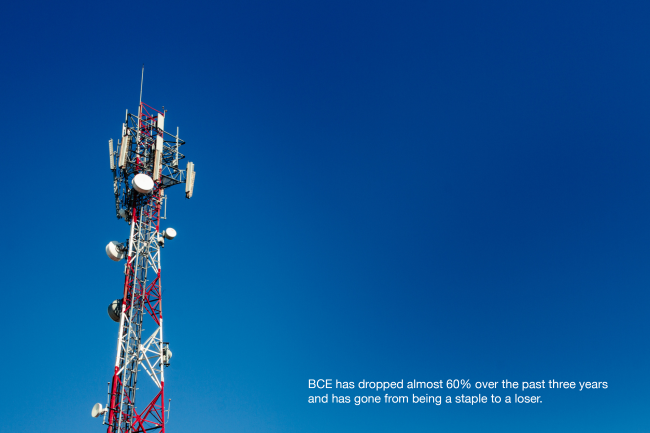
For many Canadian investors, BCE is a core holding. It’s been in their portfolios forever and paid a healthy dividend along the way. Over the past three years, however, the stock has dropped almost 60 per cent and management recently announced that the dividend is being cut by a similar percentage. The stock has gone from being a staple to a loser.
I have no issue putting BCE in the loser category, but find that investors too often use the term incorrectly. Let’s look at the reasons why a stock might not perform as hoped.
Oops
The most obvious reason is that the investment thesis is wrong. The new product turns out to be a bust, international expansion isn’t working, or a much-hailed acquisition is a disaster. It happens regularly. BlackBerry failed to read the tea leaves. Nike is getting outflanked by cool new brands. Predicting the future is hard, but it’s not the most common reason for disappointment.
Market
The biggest reason is one you can’t control: the market. A company could be doing all the right things, and yet its share price gets dragged down by a market correction.
I’m focusing here on losers, but it goes both ways. I had the good fortune of the opposite happening early in my career. I was a conglomerate analyst and recommended that our clients buy CP Ltd., which at the time was one of Canada’s most important stocks. The call worked out brilliantly because the market went on a tear shortly after my report was published. CP got carried along and so did my reputation. I don’t remember if my thesis was correct or not. It didn’t matter. The market ruled the day.
Paid too much
Sometimes stocks perform poorly because you pay too much. Getting the outlook right is important but so is paying the right price. Howard Marks of Oaktree Capital captured it best when he said, “No asset can be considered a good idea (or a bad idea) without reference to its price.”
Overpaying takes many forms. For companies on a roll, the assumed rate and durability of growth can be overestimated and – if those sunny expectations come with a high price-to-earnings multiple (P/E) – then everything must go right for you to make money. There’s little room for error.
For cyclical companies, the opposite can happen. I learned this lesson from veteran investors such as Murray Leith and Bob Krembil. They taught me that low P/Es for airlines, heavy industrials and resources only come when companies are at the top of their earnings cycle. They knew these low-margin businesses swung back and forth between huge profits to losses, and weren’t wooed by single digit P/Es. Cyclicals need to be bought when they’re earning little or no money and have sky high P/Es.
Dividends rule
Related to valuation, investors, including many BCE shareholders, get intoxicated by a stock’s dividend yield and fail to assess the fundamentals. They’re blinded by the income and don’t question whether the company’s profits and competitive position will support the dividend.
Yield is not a valuation tool for stocks like it is for bonds. A dividend isn’t a fixed obligation like an interest payment is for a debt instrument, but rather a tool for distributing profits to shareholders, when there are profits. It’s an important distinction, as BCE shareholders are finding out.
Time frame
When a stock isn’t working out, it’s not usually because other investors have a meaningfully different view, but rather a different time frame. A day trader wants a stock to move by lunch. If it doesn’t, they sell. A long-term investor could care less what it does over the next few months, or even years. If it’s down by lunch, they’ll buy more.
Bell fits in multiple categories. The juicy dividend convinced people to buy, or keep holding, the stock, but they failed to appreciate how capital intensive and mature the cellphone and cable businesses are, and as a result, paid too much.
Is now the time to buy BCE?
Certainly, the valuation and dividend better reflect the company’s prospects. If you’re an income investor, you’ll need to compare it to Rogers, Telus and the Canadian banks, and importantly, make sure you have the right time horizon.
Your success won’t be determined by how it does in the next few months. It will take time for your dividends to accumulate and for you to determine if management’s fibre-first strategy is working out.
We're not a bank.
Which means we don't have to communicate like one (phew!). Sign up for our Newsletter and Blog and join the thousands of other Canadians who appreciate the straight goods on investing.

Steadyhand helps Canadians grow their wealth with a simpler, more human experience. Learn more.