Our Investing Tools
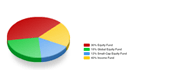
Asset Allocator
Assists you in building a portfolio of Steadyhand funds that meet your particular needs.

Fee Calculator
Shows you the fees associated with any given portfolio of Steadyhand funds.
Risk is inherent in investing and is a requirement to grow capital. In our view, the best way to reduce risk is through owning a concentrated, yet well-diversified portfolio of profitable, industry-leading businesses.
There are two types of risks associated with investing:
Systematic risk: the general risk associated with investing in capital markets. This type of risk cannot be diversified away, as it refers to macroeconomic factors – such as interest rates and inflation – that affect the market as a whole.
Unsystematic risk: the risk that is unique to a specific company. This type of risk can be largely mitigated through diversification.
Diversification comes in many forms. The basic theory of diversification is that spreading your investments across a number of securities in different sectors, industries and geographic regions reduces the risk that your portfolio will suffer a significant setback if a particular stock, industry or region is particularly hard hit.
Market-beating managers express their insights in concentrated portfolios that differ dramatically from the character of the broad market. Recognizing the merits of diversification, the question becomes how much is adequate to effectively mitigate risk. We believe that owning a core group of 20-30 stocks in a diversified cross-section of the economy provides plenty of diversification. Risk can be further mitigated by possessing extensive knowledge of the stocks you own, and by purchasing them at reasonable valuations.
It is a misconception that the more stocks you own, the better diversified you are. If the stocks you own all fall in the same industry or are exposed to the same unsystematic risks, you have achieved little diversification.
A number of academic studies have concluded that owning roughly 20 randomly selected stocks provides ample diversification to the point where there’s little unsystematic risk. The more stocks that are added to a portfolio beyond this point, the greater your chances of mirroring the index.
Overdiversification is an investing error that plagues many fund managers and investors alike. A portfolio comprised of too many stocks stands little chance of outperforming the market. Overdiversified portfolios own a little of everything but a lot of nothing and are in essence a high-cost replication of an index. Moreover, the more stocks a manager has to follow, the less of an expert on each stock they become.
Asset Allocator
Assists you in building a portfolio of Steadyhand funds that meet your particular needs.
Fee Calculator
Shows you the fees associated with any given portfolio of Steadyhand funds.